Should I Own My Own Home? Yes, and here’s why…
According to the U.S. Federal Reserve, the net worth of people who own their own homes is 36 times greater than people who choose to rent.
In dollars and cents this equates to an average net worth of $194,500 (homeowner) versus an average net worth of $5,400 (renter). This is often referred to as a “Wealth Gap”.
In a recent Forbes Magazine article, the National Association of Realtors® Chief Economist predicted that the “Wealth Gap” between those who are financially well off (homeowners) and those at the bottom of the net worth scale (renters) will widen even further in the coming years.
For minority groups, such as African-Americans and Hispanic Americans the “Wealth Gap” is even more dramatic, both today, and projections into the future.
The Hidden Wealth Creation Impact of Home Ownership…
Real estate has certain inherent wealth creation advantages that we will discuss in this book, but the bottom line is the sooner you get started moving from renter to owner the easier it becomes to create wealth through home ownership and begin to quickly close your own personal wealth gap.
Whether you are a Baby Boomer, consider yourself to be a part of “Gen X”, or you are a part of the new emerging powerhouse known as “Millennials”, the information in this book will assist you in getting into your own home, and on the path of wealth creation through property ownership.
Who is Sherman Ragland, and why it pays to listen to what I’m saying…
I’ve spent my entire adult life in the real estate business. You name it, I’ve done it: fixing and flipping single-family houses, buying and holding apartment houses, assisting small business owners to acquire commercial properties, and my personal favorite (and most lucrative) real estate wealth creation activity – land development. I’ve done it all, for over 30+ years!
I purchased my very first piece of real estate when I was 25 years old. You guessed right if you guessed it was my first home.
I am the Founder of Realinvestors® (a real estate consulting and brokerage firm that specializes in helping people to assemble wealth generating real estate portfolios), and I’m the Best-Selling Author of several books on real estate and real estate investing, including: 7 Steps To Owning Your Own Home.
Why Listen to a CCIM?
I’ve earned the coveted CCIM designation (the real estate equivalent of the CPA for the accounting profession) and my MBA is from the Wharton Business School of Business. I’m also a frequent top speaker on the topic of real estate investments as a means of wealth creation, including at the prestigious Wharton and Harvard Business Schools.
I started in the real estate business as a real estate agent in 1983, when I was a College Junior at Towson (State) University in Towson, Maryland, just north of Baltimore. Truth be told, I got my license because of a guy named Bill Burns.
At Towson you had to take what was called general university requirements, or GUR’s. Which meant to graduate you had to have at least one physical education class every year. For my Junior year I picked tennis.
The Day That Changed Everything – Real Estate…
Every day that we had class there would be this guy from the community who was also out there on the tennis court playing. He was in his early 40’s, and every day he would come out and play tennis on the adjacent court(s). He drove a convertible Jaguar, and was always dressed to the 9’s: white shirt, white shorts, white shoes, and of course, the rugged gold tennis bracelet on one wrist and a gold Rolex on the other.
One afternoon, I worked up the courage to introduce myself. I asked him what he did for a living that allowed him to come out and play tennis in the afternoon, when most people his age were either working in an office, or out digging ditches. He said he was a real estate broker.
After a couple of more times seeing Bill on the tennis court, I was intrigued about this “real estate broker” lifestyle, so I asked him how I could become a real estate broker. He shared with me what was necessary, and then he told me he taught the class needed to sit for the state real estate license (in the evening) at Towson’s College of Business.
Needless to say, I was hooked. I took Bill’s class, along with about 35 other people from the community, and at 21, I became a licensed real estate agent, even before I graduated from college.
Getting My Wharton MBA…
A year later when I graduated from Towson, I was fortunate to receive a fellowship to the Business School of my choice, and I opted to get my MBA from the Wharton School of Business.
Immediately upon graduating from Wharton, I accepted a job as the CFO – Chief Financial Officer for a land development project called Lansdowne in Northern Virginia. The project was being developed by XEROX, or more specifically, their subsidiary XEROX Realty Corp.
After completing the infrastructure for the first phase of Lansdowne, VA, I left and accepted a job as a project manager for the biggest real estate development company in downtown Washington, DC, The Oliver T. Carr Co. My job was to build office buildings near the King Street METRO (Subway) Station in Old Town Alexandria, Virginia.
Making Others Rich Through Real Estate…
After a few years at Carr, I started my own real estate investment and development company, first advising others on how to create wealth, and then following my own advice by focusing on my own real estate development projects.
In short, I’ve dedicated 30+ years of my life to the real estate business, having had my hand in every type of real estate from large scale land development projects, to downtown office buildings to developing small-scale apartment houses, and condo projects in Baltimore and Washington, DC, which is what I specialize in today.
While I love providing decent rental housing for people, the simple truth is that everyone (including the tenants in my properties) really need to consider buying their own home.
3 Quick Reasons Why Home Ownership is Better Than Renting…
Here are 3 reasons why home ownership is better than renting:
The “FORCED SAVINGS” Effect of Real Estate…
- Your Personal (Forced) Savings Account:
Today, it is quite common to see a renter in an apartment paying in rent the same amount every month as a homeowner pays for their monthly mortgage payment. In almost every case they are comparable sized townhome or apartment (Condo) units. The locations can be similar, the style can be similar, in fact in every way they are spending the same amount of money for comparable housing choices.
Some might argue “What’s the difference, it’s still money out the door!” But it really isn’t! Here’s why: The renter will pay the exact same amount of money, every month, for the term of the lease. If it is a 12-month lease, then the payments are the same. But what happens when the lease renews? Typically, in most real estate markets, rents go up on the anniversary of the lease term, and this can be anywhere between 2% to 7%. Let’s say the rent goes up by 5%, then a $500.00/month rent payment becomes $525.00 rent payment the following year. Said another way, the renter pays an additional $300.00 the following year for the same space. Now paying an additional $300.00 for the year may not sound like much, but that same renter will be paying $638.00/month 5 years later, or an additional $1,700 a year, again for the same space.
But what about the person who decides to buy, rather than rent, the property owner? At the end of the first year this new homeowner will pay the same amount the following year as they paid when they purchased. In fact, they will pay the same $500.00/month for the term of the mortgage, which is traditionally for 30 years, unless they sell sooner. While it’s true that there could be an additional increase to cover the property taxes (if included in the mortgage), but the basic mortgage amount will not change, if the homeowners selects a fixed-rate mortgage. But here’s the dirty little secret: if you are a renter, at the end of every year of the lease you own nothing. But for the homeowner, with every payment that the homeowner makes, a certain portion goes to payback the original loan from the lender. In fact, at the end of 30 years, the homeowner will owe nothing to the lender. Now think about this. If the Homeowner purchased a $200,000 condo, townhouse, or single family home, even if they borrowed 100% of the purchase price (like with a VA Loan) at the end of the 30 Year mortgage term, they will owe the bank nothing. Here’s why: a portion of each month’s “housing payment” is actually going to pay back the bank. In essence, it is going into the piggy bank known as “home ownership”. It’s really a form of FORCED SAVINGS for the homeowner.
Regardless of your saving habits, if you make your mortgage payment (as a homeowner) every month, then every month you are being forced to save. But what about the renter, don’t they get some type of monthly savings benefit? No they don’t! Every month the renter is actually paying down the landlord’s mortgage. Yes, the Landlord is using the renter’s money to pay down the Landlord’s mortgage. Here’s the dirty little secret my landlord friends don’t want you to know…. What we as landlords are really doing is getting a group of total strangers to come and live together, for the sole benefit of paying down our mortgage, and creating a savings account (a big one) for us!
Truth be told, this is one of the things I love best about owning and building apartment houses. So why “spill the beans”? Because I know that most of my renters realize this, and do not care. They choose to rent anyway, but I do not think they fully realize how much the decision to continue to rent, versus owning their own home is really costing them, until of course they retire. Many renters go through the “Should’a, Could’a, Woud’a” phase later in life, wishing that some point they had purchased a home, rather than continuing to rent. But by then, it’s too late. - Increase in Property Values – One of the reasons why many younger people do not choose to purchase a home is because they have grown up during a period where housing values actually went down. For most of my adult life, however, I have never seen housing values go down from year to year, except for the period 2008 – 2012. In fact, in almost every real estate market in the country, housing values declined during this period of time known as the “Great Recession”. But this situation started to turn around in 2014, and by all predictions, home values should continue to increase, year over year.
Is it guaranteed that home values will always go up? No, that would be impossible for anyone to promise. According to the Federal Reserve, housing values have generally gone up (just about every year) from 1932 till now. Again, there have been obvious periods where values either stayed flat, or did decline, but in just about every American City today, housing values are back to where they were in 2005, and climbing. So lets talk about what happens to renters versus homeowners when home values go up…
Renters usually do not see the benefit of rising property values. In fact, renters typically experience rent increases when home values go up for two reasons: a) When values go up, property taxes also go up. Landlords typically pass along this increase in property taxes by increasing the rents, and b) When property values go up, landlords raise rents because they know that it will be expensive for renters to move. Renters typically have fewer choices when property values go up because many landlords sell their property that they were renting, to take advantage of an increase in home values, which means fewer rental properties on the market. Fewer choices means less competition, and less competition (almost always) mean higher rents.
And what about the homeowner? The homeowner also may experience an increase in property taxes, but again, if they have a fixed rate mortgage they will not see an increase in the monthly amount that goes directly to the bank (only the portion set aside to pay the property taxes). More importantly, any increase in the value of the property is theirs to keep! They will recognize this increase in value when they sell… OR, if they choose to refinance their property. Which brings us to the (absolute) best part of home ownership. - Special Tax Treatment and Tax Savings – Real estate has always received special tax treatment by the government. If the value of your property goes up, the Landlord will often refinance. Why? Because under the tax law, the proceeds from refinancing real estate is tax free. Think about it! If the Landlord is able to refinance and “pull out” $200,000, they will not pay a penny of taxes. If the Landlord was in a high tax bracket, say 48%, they would have to earn close to $400,000 BEFORE TAXES to get the same benefit of that $200,000 tax free loan on your property. And guess who is actually repaying the loan? You got it! The renters in his property, that’s who!
…and what about that homeowner? Well they get the same tax benefits as the Landlord. Maybe they cannot refinance and “pull out” $200,000, but in a few years they can probably refinance (re-fi) and pull out $50,000 to $60,000, if the property goes up in value. AND YES… that $50,000 to $60,000 would be TAX FREE, just like the Landlord ‘s was. The tax laws are the same for the homeowner as they are for the Landlord.
So who does not get this favorable tax treatment? You guessed that right! The Renters. Renters get little to ZERO tax benefits.
BUT WAIT THERE’S MORE…
When the homeowner sells, they probably will not have to pay taxes on the “profit” they made on the sale of their home. In other words, the difference between what they paid, versus what they are able to sell for (after paying off any remaining mortgage balance, and transaction fees, such as brokerage fees).
While tax laws change from time to time, as long as I have been in this business (since 1983) there has always been some type of favorable tax treatment for homeowners when they sell their primary residence.
…and what about the renter? NO, THEY GET NOTHING! Which makes sense, as they did not own the property and therefore, they have no claim on any increase in value, or taxes due when a sale takes place. In short, they owned nothing, so they get nothing.
Bonus Time…
In addition to these 3 things mentioned above, if the homeowner decides later in life to convert their home to a rental property, they actually get a few more benefits. Such as, the ability to claim depreciation on their taxes to reduce their payments to Uncle Sam around tax time; and the ability to use their home (if they choose) as collateral for any loans.
These loans could be to purchase a new home, or a second (vacation) home, or to start a business or send their kids to college. Once again, The Renters Get NOTHING. If you do not own the property, you do not get the benefits.
Without a doubt, I would say that the single biggest financial mistake anyone can make in their lifetime is to rent (long term) instead of owning your own home.
The 7 Step Process To Getting Your Own Home…
So now that we’ve discussed the 3 major benefits of home ownership, let’s talk about my 7-step process to get you into your own home. This is a process that anybody can follow if they want to own their own home.
Step #1 – DECIDE!
The first step is to decide that you want to become a homeowner.
I want you to put your thinking cap on, and I want you to really think about your life, and whether you want to have 45 times more net worth in a few years, or whether you want to stay where you are now, financially speaking? Are you o.k. going to the store for food, and having to go through 3-4 credit cards at the checkout line, before you find the “good one”? Are you sick and tired of looking at opportunities like: Starting a business, or going on the trip of a lifetime, or getting a new car (to replace your clunker), but having to tell yourself… “I can’t afford this!”
It is smart to not overspend, but the bottom line is that there will be opportunities in life to make an investment in something that will make a difference. If you own your own home, you may be able to borrow, or get a home equity line of credit, or HELOC. As a renter, this is not even an option. The key, of course, is homeownership. So, decide that you want to do it. That’s the first step.
Step #2 – Get An Honest Financial Assessment
The second step is to have an honest financial and credit assessment. You need to look at how much money you have right now. In addition, you need to answer the questions: “How much money do you spend on housing now?” and “What is your credit score?”
Look at your wallet, and really be honest about your situation. What I’m sure you’re going to find, is that in many, many cases, if you were to be making a mortgage payment (for a comparable size and style living arrangement), you would actually be saving money every month versus what you’re paying in rent.
So that’s why I say an “honest” assessment. Many people simply give up on pursuing homeownership because they “Think it will cost more”, and yet the simple truth is that often it is the same, or less.
This is especially true if you qualify for one, or more, of the special home ownership financing programs available today.
Step #3 – Identify Sources of Mortgage Money.
There are many sources today to get (cheap) money for you to make your down payment and to make your payments on your mortgage, especially if you’re elderly, or a member of the first time home buyer community, or if you’re a millennial.
There are many special government sponsored programs and sources of money just for first time homeowners – both federal and state.
And, if you’re a current (or former) member of the military, you can even get a 100% of the down payment taken care of for you. The Department of Veterans Affairs (VA) has a longstanding program which offers this 100% financing option just for Vets.
There are special sources of money for a wide variety of groups of people interested in owning their own home.
Many employers and state housing offices provide assistance programs for various categories of homebuyers. You simply need to do some research, or simply ask knowledgeable people in the real estate business. Someone who can help you find these sources of many as your champion.
Step #4 – Get Yourself a Champion!
Now, here’s the big secret about the residential real estate industry. In every real estate transaction, there are 2 real estate agents: one for the seller and one for the buyer.
A lot of people don’t realize that homebuyers can hire their own agent, called a Buyer’s agent AND THEIR FEE IS ACTUALLY PAID BY THE SELLER! You read this correctly. Your Buyer’s Agent is YOUR CHAMPION, meaning they go into battle to fight for you. But… their fee (or commission) is actually paid for by the Seller.
You need to get a champion, somebody who is going to fight for you and who is going to look out for your interests, and you don’t even have to pay for it.
Be smart. Find the best Buyer’s agent you can. Their fee will be paid by the seller, and the price is the same whether your agent is THE BEST, or THE WORST. You might as well get the best, since the Seller is going to be paying the real estate commission, which includes their fee. Get a Champion, then go shopping for FREE!
Step #5 is GO SHOPPING!
Yeah, that’s right, “Shopping” for a house costs you nothing. Today, with the internet and so many real estate websites on the internet, you could do a lot of the shopping right on your cell phone. You never even have to leave the comfort of your own home.
Yes, at some point it will make sense to go and visit properties, but with technology today you can actually see more about a house online then you can by visiting it. Drones can give you a birds-eye view of the neighborhood, the adjacent properties and best of all, every detail of the property from the air, like the condition of the roof.
Once you find what you want, your Buyer’s Agent will write it up and present it to the Seller’s Agent. After the contract terms are established, you can ask for the right to have the home inspected, and you should go with the home inspector to see things through the eyes of the pros about the condition of your (prospective) new home.
…and if you cannot take off work, your Champion (your real estate agent) will even represent you and video tape the walk through with the inspector. Shopping is the fun part!
Step #6 – LET YOUR CHAMPION HAMMER OUT THE BEST POSSIBLE DEAL!
Despite the explosion in online real estate websites, the vast majority of homebuyers (90%) stated that they want someone else to represent them in finalizing the contract and closing the deal. Your Champion, your Buyer’s Agent should be exceptional when it comes to representing your interest in finalizing the contract.
Remember, what the Seller wants is just their opinion. Regardless of what you see on the Internet, housing transactions are always negotiated.
There is no such thing as a “Fixed price”, even in new housing developments. But finalizing the contract is more than just getting you the best price and terms. Finalizing the contract is where all the I’s are dotted and the T’s are crossed.
This is very important, because once the transaction is over, you are not going to get anything else, so anything you want to get in terms of home repairs, move in condition, what stays and what goes, or changes to the property, has to be in the contract before you sign it.
Step #7 – GET YOUR KEYS AND MOVE IN!
Getting the keys to your new home, and moving in is the super fun part of the whole transaction.
Oh, my gosh. The joy that you will feel when you own your own home is unlike anything that you will ever experience, except maybe the joys of becoming a parent.
That’s why I’m so excited every time I’m able to guide somebody into their first time home ownership. It’s the smartest and best thing you can do.
EPILOGUE (How I Became The Realinvestor®️)…
I am often asked, “Sherman, do you remember your very best real estate deal?” My answer is always the same: “Of Course, it was my first purchase of my own home when I was 25 years old!” Now understand, I have been involved in some of the biggest real estate projects in my hometown of Washington, DC.
I was “Employee #2” in the development of Lansdowne, Virginia. I was on the development team that created Carlyle in Old Town Alexandria, VA (home of the US Patent Trademark Office, the Eastern District Federal Court House, and home of the National Science Foundation), and I served as the Financial Advisor (Broker) to the Government of the District of Columbia in the $100 Million dollar sale of the land on Pennsylvania Avenue to the Gannett Foundation for the creation of the Newseum at 555 Pennsylvania Avenue, NW, (next to the Canadian Embassy), but none of these “mega-projects” (nor anything I’ve done since) comes close to the excitement of purchasing my first home.
My Best Real Estate Deal/ My Worst Deal…
“So, Sherman – if that was your very best deal, what was your worst?” …well interesting enough, it was the same deal!
While living in my first home, I went through some of the same challenges that every “twenty-something” goes through. I got laid off from work, I missed my mortgage payment (on more than one occasion) and had to get “caught-up”. I got divorced.
My (then) wife decided to leave, and turned her half interest in the property over to me, in exchange for an “easy” divorce, and of course no claims (on my part) to the antique furniture her family had given us as wedding gifts. Many years later, I met the woman of my dreams, who had also gone through a divorce, and I decided to move back to Maryland into the home she owned and lived in with her (now our) two children.
So, what I did was my “biggest real estate mistake”? On my own I decided to sell my 2-bedroom townhouse in Old Town Alexandria, Virginia, when I moved to Maryland. I worked diligently to get the place cleaned up, and ready for sale, then moved all my furniture into my future bride’s house. Everything moved like clock-work:
I settled on the sale of my house on Friday, we got married the next day, and then took off for a 4-week honeymoon to Israel, Egypt and then to meet the rest of her family in England. It could not have possibly gone any smoother.
About 6 months after we were married, I was talking to a friend of mine who asked me what I had done with my house in Old Town. “Well I sold it of course, when I got married.” “Oh”, he said. I asked him why, and he explained that he and his wife had two rental properties.
My “Wake Up” Call…
In fact, they made enough money on their two rentals to pay for their mortgage on their home in McLean, Virginia. I asked him how he was able to acquire his rental properties and he explained to me that he and his wife (like me) both purchased their own home when they were 25, but (unlike me) when they decided to get married, they kept both of their homes and turned them into rentals.
It took about 7 years, but the rents they received from their two first homes (now turned into rental properties) “more than paid for their monthly mortgage on their home in McLean, Virginia.
I remember going home that afternoon asking my wife, “Honey, why did I sell my house when we got married?” To which she replied, “I don’t know, but you did it before we got married and you’re the real estate guy, so I just assumed you knew what you were doing. But if it had been me, I would have kept it!” At that moment it hit me… how could the “real estate guy” make such a dumb move, as selling a property he didn’t need to sell?
As I write this book, I would be celebrating the 30th year of ownership of my first home. That house today is worth over $500,000, and I would be making my VERY LAST mortgage payment this year. That means my net worth would have increased by $500,000 this year, by simply buying, keeping and renting out my very first home.
So yes, the “Worst” real estate deal I ever did, was also the “BEST” real estate deal I ever did. More importantly, this mistake (selling when I did not need to do so) is what has propelled me into a “ministry” of telling people why they need to own their own home, and use it as a “stepping stone” to build a wealth creating real estate portfolio.
Wealth you can, one day, share with your children’s children. I guess someday I’ll write another book called “WHY YOU NEED TO HOLD ON TO YOUR PROPERTIES”, but that’s a lesson (and book) for another day!
Now, obviously, there’s a lot of details I wasn’t able to go into and that’s why we have a website with everything you need to know about getting ready for homeownership, interviewing and selecting the right Champion and Insider’s Secrets to getting the best deal possible when pursuing the 7-Steps to Owning Your Own Home. To access these resources simply go to:
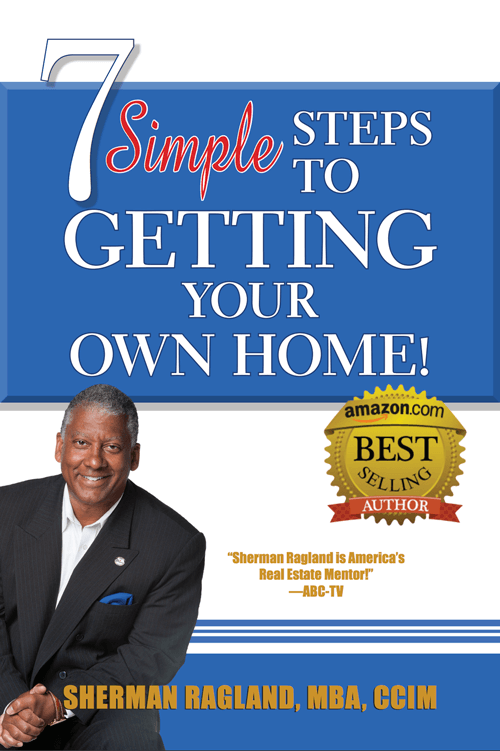
In This recent interview with Sherman Ragland of RealInvestors® based in DC/MD/VA, Sherman Ragland appeared on ABC’s Talk Street in Texas as he spoke about his book “7 Simple Steps to Getting Your Own Home” and how with his book and instructions you to can own your own home.
Interested in home ownership?
If your considering owning a home you need this book containing, well obviously, 7 simple steps to getting your own home. Written by Sherman Ragland who is the Founder of DC-REIA.COM, the Greater Washington, DC Real Estate Investors’ Association, the largest and most successful real estate training organization in the DC, Northern Virginia and Central Maryland region
.
Do You Live in the Greater Washington, DC Region…
Here’s a great Meetup to learn more about how to get into your very own home. In addition to great information, you’ll get a free breakfast and confidential advice from professionals who specialize in working with First Time Home Buyers: https://www.meetup.com/DC-PG-FIrst-Time-Home-Buyers/